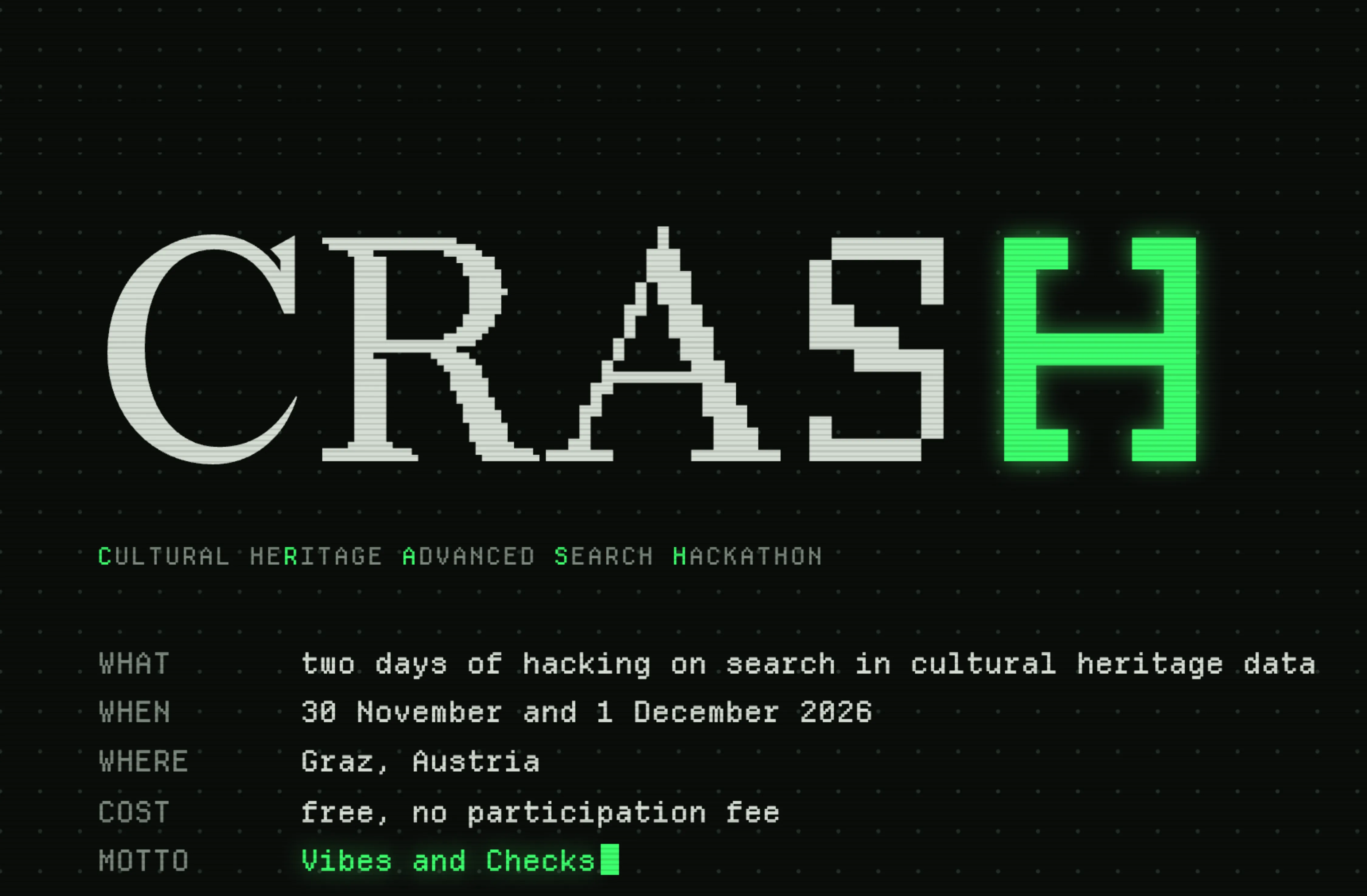
CRASH Hackathon
Cultural Heritage Advanced Search Hackathon
When: Monday, 30. November and Tuesday, 1. December 2026
Where: UNICORN Startup & Innovation Hub
Schubertstraße 6a, 8010 Graz, Austria
Registration: Registration is free of charge but mandatory: Please register by 1. November 2026 latest via this registration form . Hacking is on site only.
Language: The event language is English. A little German in the team helps, because some datasets have German in them.
Search is at the heart of research. A researcher knows what a good search tool does for them: it lets them move through a collection, it lets them steer the result, it is fast, and it works on the next dataset as well. Research software often falls short at this point.
Search is retrieval, and what a tool retrieves reflects the question: the results are the items most similar to the query. Similarity is the first decision in every search tool, and most tools make it for the user and hide it. But finding is only the start. A good tool also shows why a result is there. It lets the user change what similar means and see the results follow. It works for people who read with a screen reader or in another language. It says what one search costs in time and energy. And now and then it finds the thing nobody asked for. CRASH is about tools that do this work in the open, so that the user can see it and steer it.
For two days, CRASH puts cultural heritage data and the people who care about it in one room.
CRASH websiteVibes and Checks
Vibes
Build what you want, with your team, your data and your problem.
Winner of hearts, chosen by the room.
Checks
Pick one thing to do well, and show at the end how you checked it.
Winner of numbers, chosen by the jury.
Every team picks one focus area. In the final presentation, the team shows one check for that area: what it tested, and how. There are two rankings, one by the room and one by the jury, each with places one to three. The prizes are small and symbolic.
| Area | Question | Example of a check |
|---|---|---|
| Efficiency | What does one search cost? | time, compute and energy per query |
| Trust | Can I see why this result is here? | every result links to its record; the same query gives the same answer twice |
| Control | Can the user steer the outcome? | the user changes what similar means, and the results follow |
| Access | Who can use it? | screen reader, voice, plain language, a second language |
| Discovery | Does it find the weird things? | measures beyond accuracy: diversity, serendipity, dissimilar items |
Agents are welcome in every area. How you build is your choice.
Topics
Some examples of methods we would like to see:
- retrieval over image, text and layout at the same time
- embeddings for every kind of object, and an account of what they miss
- re-ranking that improves a result list without burying it
- retrieval-augmented generation (RAG) that cites its sources and says where it found nothing
- agents that search on a user’s behalf and keep a log of what they did
- vision-language models that read handwriting
- search across languages, scripts and the eight spellings of one village
- detection of copies, forgeries and near-duplicates
- recommendation and exploration as an alternative to the query box
- knowledge graphs and linked open data
- evaluation beyond accuracy
- the cost of one query in watts
Some examples of material:
- charters with and without seals
- manuscripts with their marginalia and doodles
- newspapers with text recognition from 2009
- letters, diaries and account books
- maps that disagree with each other
- museum objects described in three words
- photographs without captions
- audio, film and 3D scans
- catalogue cards that describe other catalogue cards
- metadata in every standard, and in none
Who can come
We invite students, researchers, practitioners and experts from academia, memory institutions and industry, for example:
- hackers
- people from natural language processing (NLP) and computer vision (CV)
- data stewards
- curators
- archivists
- librarians
- designers
The list is not complete. If the event interests you, register.
The most valuable thing you can bring is your team, or part of your lab, with a dataset and a problem you know well. If that is not possible, come on your own. You then bring something the room can work with: a skill, a dataset, or a problem. You do not have to code. We especially encourage people of genders underrepresented in tech to register.
The invitation goes to the institutions of CLARIAH-AT, to partner universities, and to CLARIN and DARIAH institutions in the countries around Austria and beyond. Places are limited. We read every registration, and we put the room together so that the teams are strong and mixed.
The event language is English. A little German in the team helps, because some datasets have German in them. Hacking is on site only.
More detailed information is available at the dedicated CRASH website:
CRASH website